Work we've been part of.
A look at some of the programs we've contributed to — the areas we worked in, and how we engaged.
Embedded Engineering for a
Next-Generation Silicon Program
YantraVision contributed across silicon validation, ML compiler stack development, and test automation — working within the client's team and processes across a multi-phase silicon program.
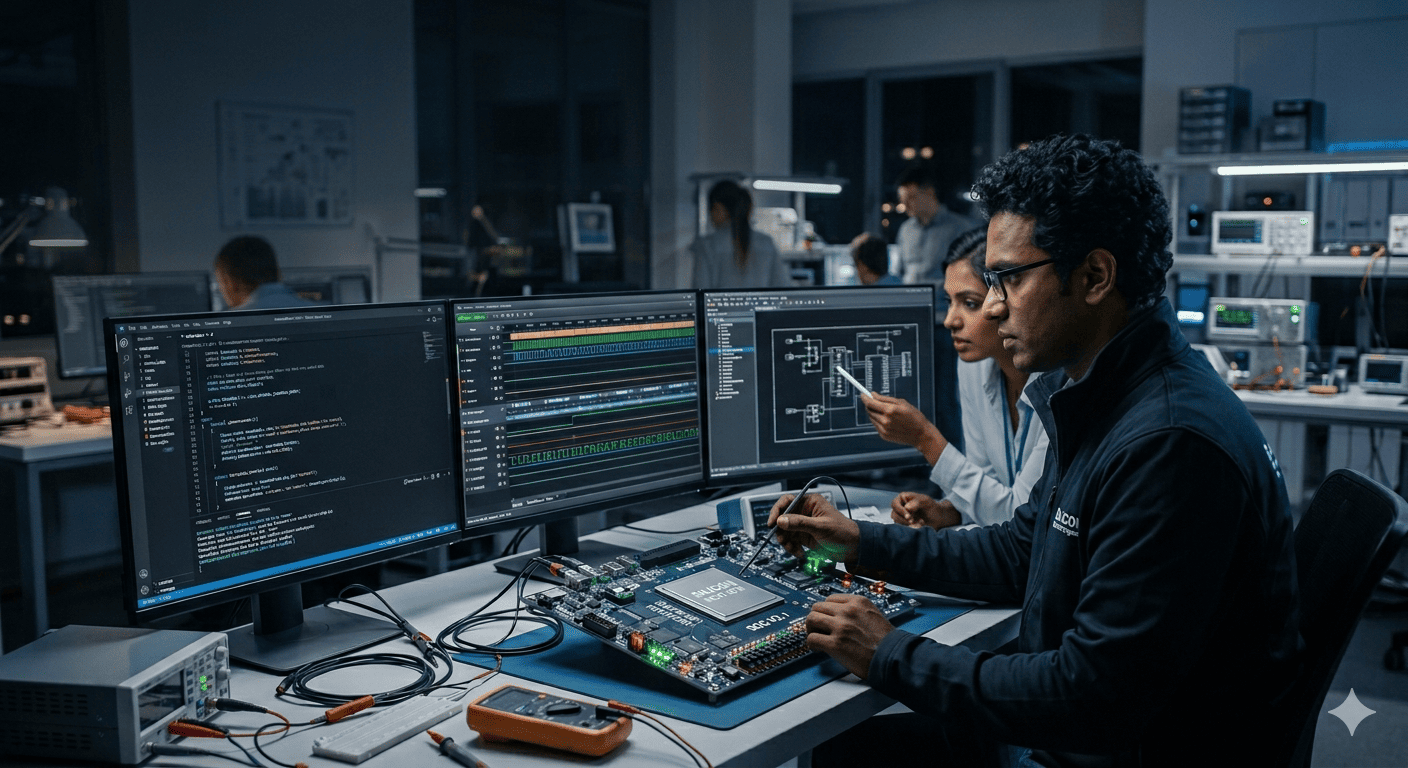
An on-device AI compute architecture,
built for inference at the edge.
The client was developing a next-generation silicon architecture designed to run machine learning workloads on-device, without reliance on cloud infrastructure. The program covered the full silicon lifecycle — from architecture definition and pre-silicon modelling through to post-silicon bring-up and production validation.
The scope included the silicon itself, the software stack that exposes it to ML frameworks, and the validation infrastructure that covers both environments. YantraVision was brought in to contribute across all three areas, working as part of the client's engineering organisation rather than as an external delivery stream.
"We worked within their team — using their tools, their processes, and their workflows. The work was assigned, reviewed, and delivered the same way as any internal contribution."
Integrated into the team,
not alongside it.
The engagement model was embedded from the start. Work was tracked in the client's issue management system, reviewed through their code review process, and delivered against their release milestones. There was no separate project management layer or dedicated interface between YantraVision engineers and the client's teams.
Engineers worked directly with counterparts in the client's silicon validation, compiler, and test infrastructure teams. Handoffs were direct. Decisions were made in the same rooms — or on the same calls — as the client's own engineers. This applied across all three workstreams throughout the program.
Three workstreams,
running in parallel across the program.
Across multiple phases,
from pre-silicon through to production readiness.
The engagement covered multiple phases of the silicon program. Work began during the pre-silicon phase, where the focus was on simulation environments, architecture-level validation, and building the automation infrastructure that would carry through to physical silicon. As the program moved into post-silicon bring-up, the same frameworks and test cases were ported and extended to run on physical devices.
Each phase brought changes in scope and priority, and the contribution areas shifted accordingly. Silicon validation activity increased significantly during post-silicon bring-up. Compiler stack contributions were concentrated in the mid-phase, around stabilisation. Test automation work ran throughout and was maintained across both environments simultaneously.
Interested in a similar engagement?
We work within your team, contribute to your program, and move at your pace.
Porting a Machine-Vision Pipeline
Across FPGA Generations
Migrated a production grain-sorting vision pipeline from Spartan-II to Kintex-7 — updating two HDL stages, redesigning sensor and ejection I/O, and cutting over with zero interruption to production throughput.
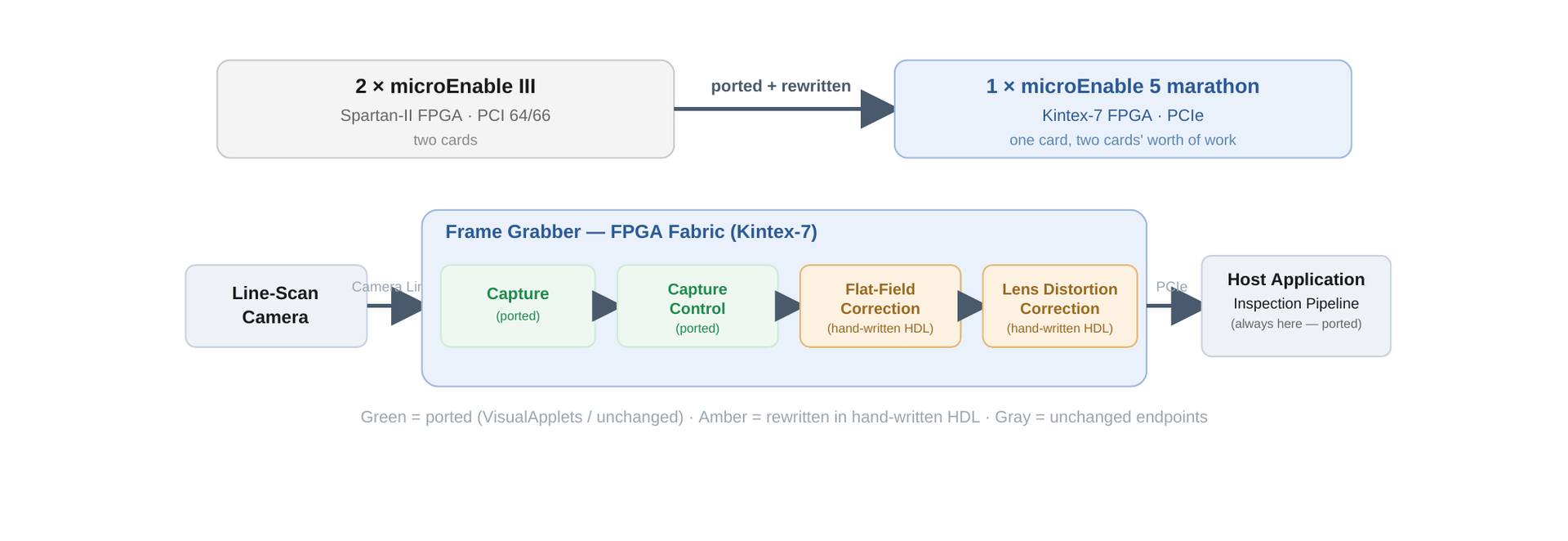
End-of-life silicon, no drop-in replacement
The client's grain-sorting machines ran a custom FPGA pipeline built on Xilinx Spartan-II — a platform that had reached end-of-life. Spare boards were running out, and any hardware failure would halt the production line with no replacement path. A migration was unavoidable, but the pipeline was processing live grain streams at pixel-rate speeds with tight real-time constraints.
The risk was compounded by incomplete documentation. The original HDL had been written by engineers who were no longer available, and two of the pipeline stages had undocumented timing dependencies between them.
Reverse-engineer, port, validate — without stopping production
YantraVision began with a full audit of the existing HDL — tracing every signal path, documenting timing assumptions, and identifying the two stages with undocumented inter-stage dependencies. We then selected Kintex-7 as the target platform.
The port was done in two phases: sensor interface and pixel acquisition (updated for Kintex-7 LVDS I/O), then ejection control (GPIO remapped, ejector timing preserved). Both stages were validated against recorded pixel streams before any hardware was swapped. Cutover was done during a scheduled maintenance window with no production interruption.
The full signal chain — camera to ejector
The grain-sorting pipeline spans four hardware layers. Only the FPGA processing board changed during migration; the Basler camera and Silicon Software microEnable frame grabber upstream, and the ejector bank downstream, were preserved in-place.
Production continuity. Zero sorting errors on cutover.
The migrated pipeline met all original throughput and accuracy specifications on first production run. The client now runs on a supported platform with a clear upgrade path for future Kintex generations.